
 WhatsApp

Miami Expungement and Record Sealing Lawyer
An arrest can leave a public record even when the prosecution ends without a conviction. If a Miami-Dade case is affecting a job application, housing search or professional plans, the first question is what the court record actually says. Sealing or expungement may be available. This page explains ordinary court-ordered relief, which requires an application and a court order. Separate procedures, including limited automatic sealing of FDLE records, may apply; that automatic process does not seal local records.
Valiente Law helps people review Florida criminal records and the available court process as part of our Miami-Dade criminal defense practice. Bring the case number, final disposition and any deadline you are facing. We can discuss the record you want addressed, the information still available and the limits of the relief you are considering.
What is the difference between sealing and expungement?
Sealing restricts public access to a record that is retained. Expungement, also called expunction, generally requires criminal justice agencies to destroy the covered record, with exceptions. FDLE retains a confidential record, and agencies may keep a notation of compliance. Neither remedy guarantees that every private copy or online reference disappears.
Ordinary court-ordered sealing is governed by section 943.059, Florida Statutes. Ordinary court-ordered expunction is governed by section 943.0585. Special procedures exist for some records and should be evaluated separately.
Who may qualify to seal or expunge a Florida record?
Eligibility depends on more than whether this was your first arrest. Review the exact charge, disposition, prior adjudications, earlier record relief and completion of applicable supervision. Some offenses are excluded under section 943.0584. For those exclusions, a qualifying guilty or no-contest plea can matter even if adjudication was withheld.
A dismissal or acquittal can support an expunction review, but it does not establish every requirement. A withhold of adjudication is not itself an order sealing the case. Prior-sealing requirements and exceptions depend on the particular route. Do not assume everyone must wait ten years, or that anyone with a withhold can immediately expunge a record.
Tell your lawyer about all prior cases and prior sealing or expunction orders, including records you believe are no longer public. Ordinary relief has restrictions on prior relief and the incidents covered. Do not choose a record to petition for without considering your complete history.
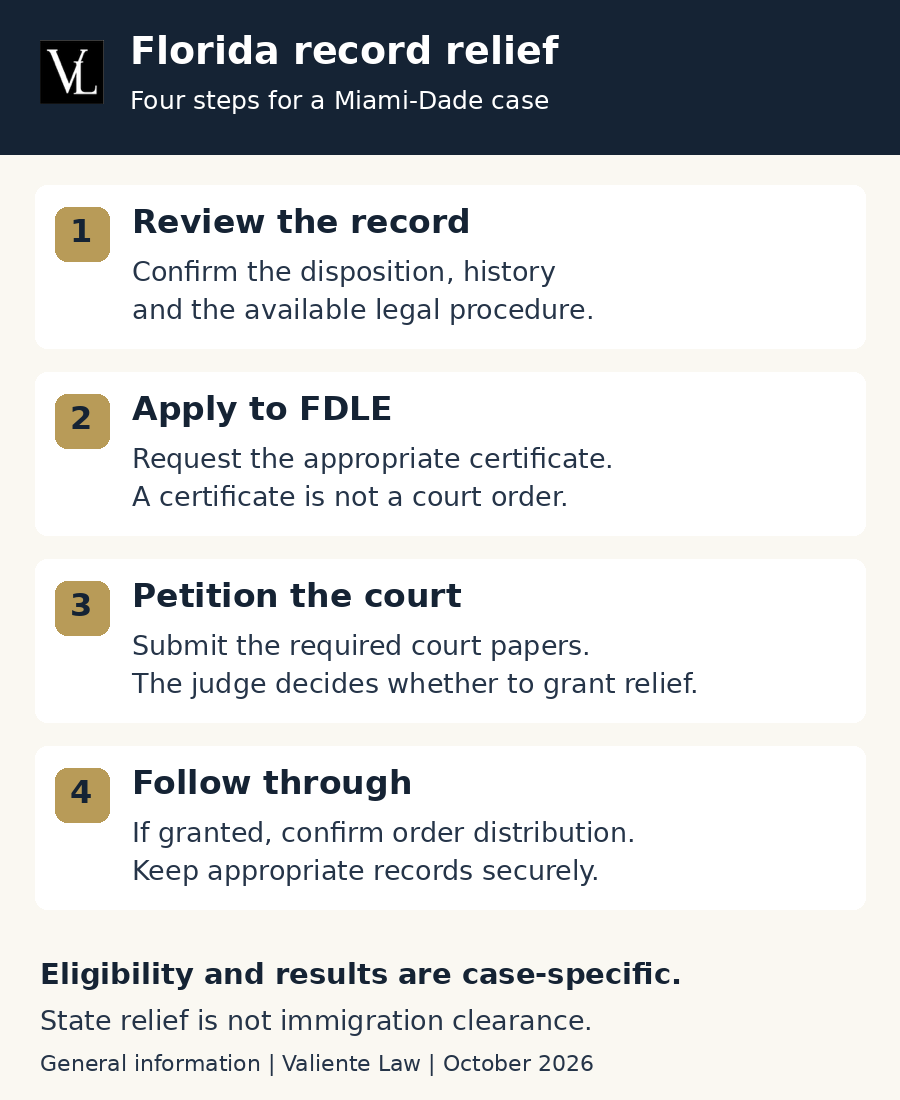
Four steps in a Miami-Dade record-relief review
1. Confirm the record and eligibility
Identify the arresting agency, case number and disposition of each charge. Obtain the court paperwork rather than relying on a commercial background report or a memory of what happened. Review whether supervision ended and which procedure fits the record.
2. Apply for the appropriate FDLE certificate
For ordinary court-ordered relief, start with the FDLE certificate-of-eligibility application. Follow its current instructions for the application, fingerprints, certified dispositions and required payment. Expunction applications also require the prosecutor’s written certified statement. Missing or inconsistent information can delay review.
3. Petition the court
An FDLE certificate is not a sealing or expungement order. The court stage requires the appropriate petition, supporting sworn statement and valid certificate. The Miami-Dade State Attorney’s court-process guide describes this separate stage. Confirm current filing and service requirements for your case. Eligibility does not guarantee the judge will grant the petition.
4. Follow through after an order
If relief is granted, retain the order and confirm the required agencies receive it. Keep the underlying documents you may lawfully retain in a secure place. Review any remaining public or private report separately. A court order does not mean every database has updated immediately.
What should I gather before a consultation?
- Case numbers, arrest or notice-to-appear dates, and the names of the agencies involved.
- The final disposition for each charge and any plea, judgment or sentencing paperwork you have.
- Documents showing the end of probation or other applicable supervision.
- Information about earlier cases and any prior sealing or expunction orders.
- The specific background report, licensing question or application deadline that prompted the inquiry.
You do not need to send sensitive records through a general website form to request a consultation. Start with basic contact information and ask how documents should be provided securely. If a record is already sealed, ask counsel about the appropriate way to obtain or share it.
First offenses, theft cases and dismissed charges
People facing a first petit theft or shoplifting charge often want to know whether the record can eventually be limited. Evaluate that question before accepting an agreement, not only after the case ends. The same planning can matter in other Miami-Dade misdemeanor cases.
Miami-Dade pretrial diversion, a dismissal, a withhold, sealing and expungement describe different things. Completing a program is not the same as obtaining a record-relief order. Confirm the actual disposition and then review eligibility. If the criminal case is still pending, keep following court dates and release conditions while discussing longer-term record concerns.
Noncitizens: Florida record relief is not immigration clearance
Sealing or expungement should not be treated as a way to eliminate federal immigration consequences. A state rehabilitative procedure does not necessarily remove a conviction for immigration purposes. Federal law applies its own rules, and a Florida withhold can still matter.
Before a plea, an immigration filing or a record-relief petition, discuss your status and plans with criminal defense counsel and, where appropriate, qualified immigration counsel. Ask which certified records should be preserved and what the particular federal form requires. Do not answer an immigration question based only on a Florida rule allowing some people to omit a covered arrest.
Disclosure and background-check limits
Florida permits a person to deny or omit certain covered arrests in some circumstances, but there are important exceptions. Criminal justice employment, some licensing and education or care-provider screening, and other specified situations can require disclosure. The exceptions for sealing and expunction are not identical.
A change effective July 1, 2026 added an exception for people screened through the Care Provider Background Screening Clearinghouse by a qualified entity. Review the current statute and the exact question before answering an application. Do not assume a sealed or expunged record can never be considered.
If a private screening report still displays information, keep a copy of the report and discuss the appropriate correction or dispute process. Do not assume the court petition resolves every separately held record or guarantees a job, license or housing approval.
Common sealing and expungement questions
Is a dismissed case automatically expunged?
No. A dismissal ends the charge, but ordinary court-ordered expunction has its own eligibility review and application process. Confirm the final disposition and review the record separately.
Can I seal a first-offense misdemeanor?
Possibly, but being a first offender is not enough by itself. The offense, disposition, history and applicable supervision all matter. Review the complete record before assuming it qualifies.
Does a withhold of adjudication guarantee eligibility?
No. A withhold does not override excluded-offense rules or other requirements. It also does not itself seal the record or settle the federal immigration question.
How long will sealing or expungement take?
Timing depends on obtaining documents, FDLE review and court processing. Check the current agency guidance rather than relying on a promised completion date. Tell your lawyer about application deadlines, but do not assume the process can be expedited to meet them.
Does the FDLE certificate expire?
For ordinary sealing or expunction, the certificate is valid for 12 months after the date stamped on it. If it expires, a new application is required and current eligibility must be reviewed. Plan the court stage promptly.
Will expungement remove every background-check or immigration issue?
No. Official access and disclosure exceptions remain, private records may need separate attention, and federal immigration consequences require their own analysis. Review the specific concern rather than relying on the label expunged.
Discuss your Miami-Dade criminal record with Valiente Law
Tell us which case or record concerns you and whether you have a job, licensing or other deadline. We can review the paperwork, explain the available process and discuss what record relief would and would not accomplish.
Call 305.764.5460 or request a free, confidential consultation. Se habla español. Falamos português.
This page provides general information, not advice about a particular case. Eligibility and outcomes depend on the facts and applicable law.