
 WhatsApp

Miami Misdemeanor Lawyer
A misdemeanor charge can affect your freedom, record, job and immigration status. It may begin with an arrest or a notice to appear, but either one can require you to attend court and respond to a criminal accusation.
Valiente Law represents people facing misdemeanor charges in Miami-Dade County state court. We can review the accusation, the evidence and the consequences that matter to you. If this is your first case or you are not a U.S. citizen, tell your lawyer early so those issues can be considered before any plea or diversion agreement.
Call 305.764.5460 for a free, confidential consultation. Se Habla Español.
What is a misdemeanor in Florida?
Florida law defines a misdemeanor as a criminal offense punishable by no more than one year in a county correctional facility. A misdemeanor is different from a noncriminal violation. It is also different from a felony, which can be punishable by imprisonment in a state correctional facility.
The label alone does not tell you how a particular case will end. The State still must prove the charged offense, and the available options depend on the evidence, your history, the statutory subsection and the circumstances of the case.
First-degree and second-degree misdemeanor penalties
| Degree | Maximum jail term | Ordinary maximum fine |
|---|---|---|
| First-degree misdemeanor | 1 year | $1,000 |
| Second-degree misdemeanor | 60 days | $500 |
These are maximums, not predictions about a sentence. Florida law permits higher fines in specified circumstances, and costs, restitution, probation conditions or offense-specific consequences can be separate. Prior convictions or additional facts can also change the degree of some charges.
Misdemeanor probation is generally supervised for no more than six months unless the court specifies otherwise. Florida law allows up to one year in certain cases where alcohol or specified substances are a significant factor. The actual sentence and conditions depend on the case.
Common misdemeanor charges in Miami-Dade
The charging document and statute control. The examples below describe ordinary classifications, not every exception or enhancement.
- Petit theft and shoplifting: ordinary value-based theft below $100 is generally a second-degree misdemeanor, while $100 or more but less than $750 is generally a first-degree misdemeanor. Property type, location and prior theft convictions can change the classification. See our Miami petit theft and first-offense guide.
- Criminal mischief: willfully and maliciously damaging another person’s property is ordinarily a second-degree misdemeanor when the damage is $200 or less and a first-degree misdemeanor when the damage is more than $200 but less than $1,000. Damage of $1,000 or more, certain prior convictions and special property or circumstances can lead to a felony or other consequences. Read about criminal mischief charges and damage disputes.
- Resisting an officer without violence: section 843.02 classifies resisting, obstructing or opposing a covered officer or other authorized person in the lawful execution of process or a legal duty, without offering or doing violence, as a first-degree misdemeanor. Whether the person was lawfully executing a legal duty and whether the conduct amounted to resistance, obstruction or opposition require fact-specific review. Read our resisting-without-violence charge and defense review.
- Battery: ordinary simple battery can be a first-degree misdemeanor. Prior battery-related convictions and other circumstances can reclassify the offense. A battery charge can also carry consequences beyond the ordinary misdemeanor maximums depending on the relationship and allegations.
- Assault: ordinary simple assault is generally a second-degree misdemeanor. Aggravating circumstances can support a different charge.
- Trespass in a structure or conveyance: this is ordinarily a second-degree misdemeanor, but the presence of a person in the structure or conveyance can make it a first-degree misdemeanor. Being armed can change the charge to a felony.
- DUI and criminal traffic charges: these can have separate license, sentencing and administrative consequences. See our Miami DUI defense overview for that distinct subject.
This page is a misdemeanor overview. Specific charge pages should address the elements and exceptions in more detail. For broader categories, visit our Miami criminal defense overview.
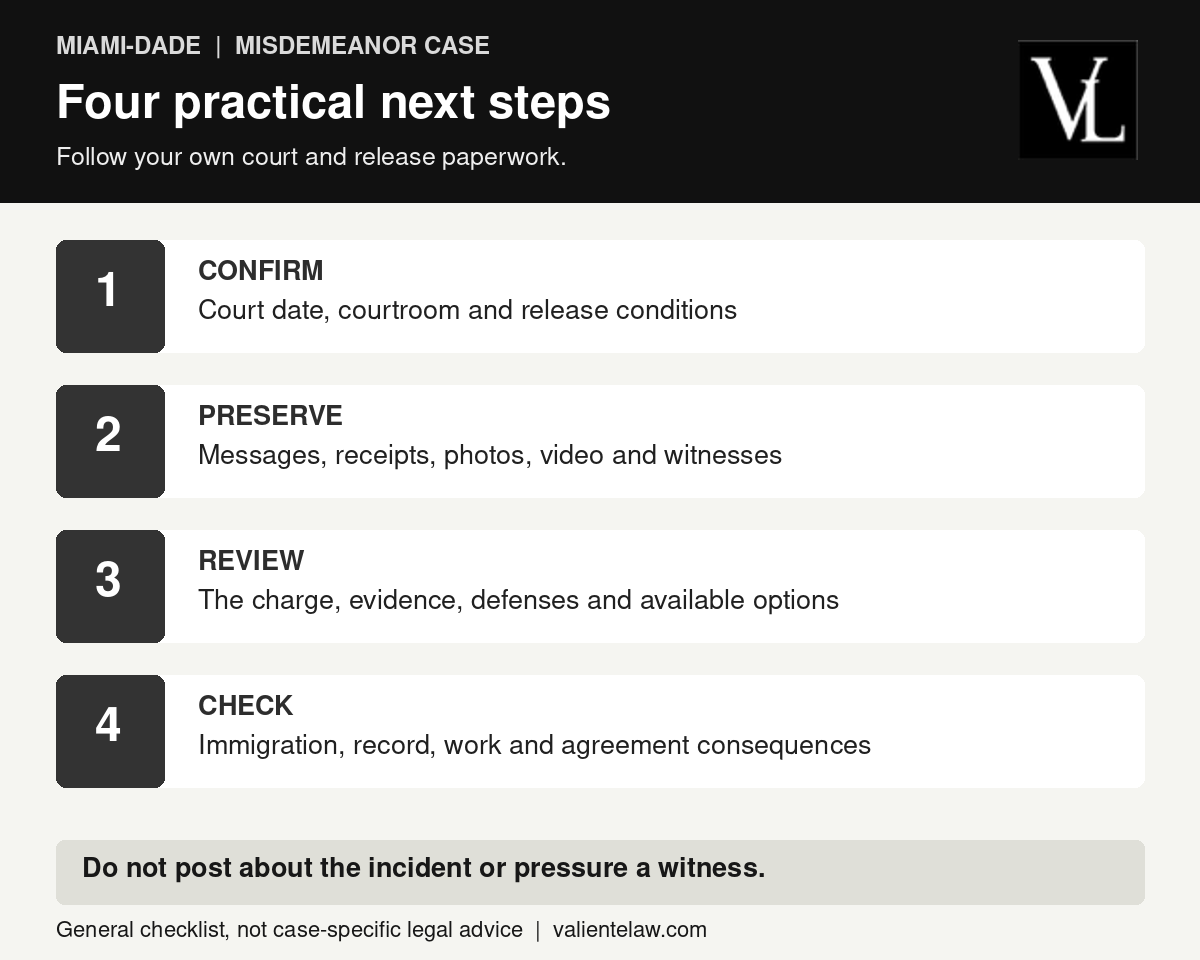
What should you do after a misdemeanor arrest or notice to appear?
- Confirm every court date and release condition. Keep the paperwork together and make sure the court and your lawyer have accurate contact information. A notice to appear is not permission to ignore the case.
- Preserve information without changing it. Keep messages, receipts, photographs, recordings and other records you already have. Do not delete, edit or post about the incident. Tell your lawyer promptly about surveillance video or witnesses so preservation options can be evaluated.
- Review the actual charge and evidence. The arrest label is not a substitute for the statute, charging document and discovery. A defense review may address identity, intent, witness reliability, body-camera or store video, ownership or consent, value or damage, and whether evidence can be used in court.
- Understand consequences before accepting an agreement. Ask what a plea, withhold, diversion program or probation term would require and how noncompletion would be handled. Discuss immigration, work, licensing and record concerns before deciding.
Do not contact an alleged victim or witness about changing a statement or dropping a case. Follow any no-contact order. Your lawyer can explain the proper way to address evidence and communications.
First-offense misdemeanor and diversion questions
A first arrest does not guarantee dismissal, diversion or a sentence without jail. It can still be important when evaluating the available options.
Section 948.08, Florida Statutes, provides an eligibility route for certain first offenders and people with no more than one prior nonviolent misdemeanor. Program approval and required consent still matter. Eligibility under the statute is not the same as acceptance into a particular program.
The Miami-Dade State Attorney’s Office describes pretrial diversion as an alternative to prosecution and states that charges are dropped when an admitted participant completes all conditions and remains arrest-free during participation. Your lawyer should confirm the current program, eligibility, admissions, written terms and effect of completion in your case.
Before accepting diversion, review any required plea or admission, classes, community service, financial obligations, deadlines, consequences of noncompletion and how completion will be documented. Considering diversion does not require assuming that there is no defense.
Noncitizens should review immigration consequences early
A Florida misdemeanor label does not answer the federal immigration question. Under 8 U.S.C. § 1101(a)(48), a withheld adjudication can still meet the federal definition of a conviction when the statutory plea, finding or admission requirement and a court-ordered punishment, penalty or restraint on liberty are present.
Do not assume that a misdemeanor, no jail, a withhold or a program called diversion is automatically safe. The exact statute, record of the case, proposed agreement and your immigration circumstances require individual review by criminal defense counsel and, where appropriate, immigration counsel before a decision.
Will a misdemeanor arrest or case remain on my record?
An arrest or court case can create public records even when there is no conviction. Dismissal, a withhold of adjudication, sealing and expungement are different concepts. Record relief has eligibility rules, exceptions and procedures, and it is not automatic.
Keep a certified or complete copy of the final disposition. Ask whether you may qualify to seal or expunge a Miami criminal record. State record relief does not by itself decide federal immigration consequences or every disclosure obligation.
Common Miami misdemeanor questions
Can I go to jail for a first misdemeanor?
Jail is legally possible for a misdemeanor conviction, including a first offense. The statutory maximum depends on the degree. The likely options in a particular case require review of the charge, evidence, history and applicable sentencing rules.
Do I need to attend court if I received a notice to appear?
Follow the notice and every later court order. A notice to appear can begin a criminal case without a custodial arrest. Confirm the date and courtroom rather than assuming the case will resolve without you.
Can the complaining witness drop the charge?
The prosecutor decides whether to pursue a filed criminal charge. A witness’s position may matter, but it does not automatically end the case. Do not violate a no-contact order or pressure anyone to change a statement.
Does a withhold mean I was not convicted?
The answer depends on the law and purpose involved. Florida statutes sometimes define conviction to include a plea or finding even when adjudication is withheld, and federal immigration law has its own definition. Ask the question in the context that matters to you.
Will diversion erase the arrest record?
No automatic erasure follows from completing diversion. Confirm the case disposition and then separately review sealing or expungement eligibility. A dismissal and record relief are different steps.
Talk with Valiente Law about a Miami-Dade misdemeanor charge
If you received a notice to appear or were arrested for a misdemeanor, contact Valiente Law to discuss the charge, your next court date and the consequences that matter to you.
Call 305.764.5460 or request a free, confidential consultation. Se Habla Español.
This page provides general information, not advice about a particular case. Outcomes depend on the facts and applicable law.
Featured Testimonial
Miami Misdemeanor Criminal Defense Review
Antonio took my criminal case & handled it better than any of my previous attorneys. He always answered the phone, even when he was in court. And if I didn’t get in touch with him he called me back quickly. Mr. Valiente always made me feel like I was his only & most important client. Hopefully, I won’t need the services of a criminal lawyer ever again, but if I do I will certainly call Mr. Antonio Valiente. And if anyone I know needs an attorney I will tell them to call Antonio Valiente!
Kizzie G.
Miami Misdemeanor Attorney
5/5