
 WhatsApp
Miami Criminal Mischief Lawyer
An accusation of damaging a car, breaking a window or placing graffiti can become a criminal case, even when nobody was physically hurt. In Florida, criminal mischief can be a misdemeanor or a felony. The amount of damage matters, but it is not the only fact that determines the charge.
Valiente Law represents people facing state-court criminal charges in Miami-Dade County. We can review what happened, the evidence of damage and the options available in your case. If this is your first arrest or you are not a U.S. citizen, raise those concerns before agreeing to a plea or diversion program.
Call 305.764.5460 for a free, confidential consultation. Se Habla Español.
What is criminal mischief in Florida?
Under section 806.13, Florida Statutes, the ordinary criminal-mischief offense involves willfully and maliciously injuring or damaging property belonging to another person. The statute includes graffiti and other vandalism. A damaged item alone does not establish who caused the damage or whether the required state of mind was present.
A defense review should separate several questions: What property was damaged? Who had an ownership interest? What conduct allegedly caused the damage? Was that conduct willful and malicious? What evidence supports the claimed amount? An accident, an identification dispute or evidence that the damage already existed can require a different analysis from the accusation in the arrest report.
Damage thresholds and ordinary penalties
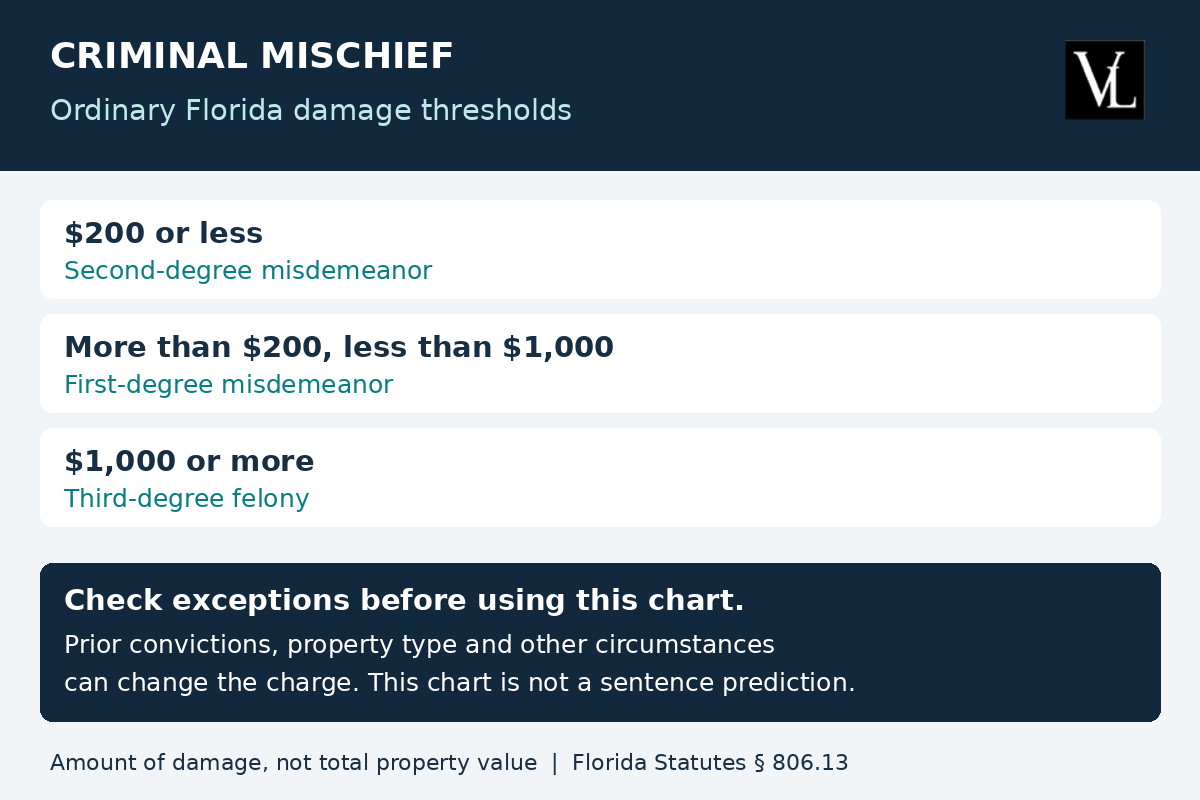
For the ordinary value-based classifications, the relevant figure is the amount of damage, not simply the total value of the property. A valuable car with a small area of damage does not automatically establish felony-level damage.
| Amount of damage | Ordinary classification | Ordinary maximum |
|---|---|---|
| $200 or less | Second-degree misdemeanor | 60 days in jail; $500 fine |
| More than $200, but less than $1,000 | First-degree misdemeanor | 1 year in jail; $1,000 fine |
| $1,000 or more | Third-degree felony | 5 years in prison; $5,000 fine |
Exactly $200 falls in the first row. Exactly $1,000 falls in the felony row. These are ordinary statutory maximums under section 775.082 and section 775.083, not a prediction of a sentence. Enhancements or special sentencing rules can change the exposure. Higher fines are authorized in some circumstances, and restitution, court costs and other conditions can be separate.
When the ordinary threshold chart does not apply
The charging subsection and the incident date need to be checked. Examples of provisions that can change the analysis include:
- Prior criminal-mischief convictions. Under section 806.13(1)(b)4, one or more previous convictions for violating subsection (1) reclassify an otherwise qualifying misdemeanor under that subsection as a third-degree felony.
- Certain property and service disruptions. Damage greater than $200 to a place of worship or a religious article there, or qualifying damage greater than $200 to a memorial or historic property, can be a felony. The statute also addresses specified business or public-service interruptions that cost $1,000 or more in labor and supplies to restore.
- Unlawful occupation or trespass with substantial damage. Section 806.13(4) makes intentionally causing $1,000 or more in damage to a residential dwelling or commercial real property a second-degree felony when the specified unlawful detention, occupation or trespass requirements are met.
- Related incidents and graffiti. Damage to property owned by different people may be combined when it occurred during one scheme or course of conduct. Graffiti convictions carry additional fine and community-service provisions. Juvenile graffiti cases have separate rules that can affect driving privileges.
The statute contains other specialized provisions, including certain telephone damage and unauthorized image projections. This is why a dollar estimate alone cannot resolve the charge. The residential-property provision took effect July 1, 2024; its expansion to commercial real property took effect July 1, 2025. Your lawyer should apply the law governing the alleged incident.
How we review the damage claim and other evidence
An estimate should be examined with the underlying evidence. Useful records may include photographs from before and after the incident, surveillance recordings, repair estimates, invoices, receipts and witness accounts. Tell counsel promptly about video that might be overwritten.
- Identity and sequence: Does the evidence show who caused each item of damage and when?
- Condition and causation: Was the condition new, preexisting or caused by something else?
- Scope and amount: What labor, materials or replacement work supports the claim, and does the claim include unrelated repairs?
- Ownership and permission: Who held an interest in the property, and what evidence bears on permission? Shared ownership or a relationship with the complaining witness is not a reason to assume the case disappears.
- Intent and admissibility: What supports willful and malicious conduct, and are there legal grounds to challenge the use of particular evidence?
These are review questions, not automatic defenses. An amount dispute can affect the classification without resolving every element of the case. Preserve records as they are. Do not edit messages, delete files or post an explanation of the incident online.
First-offense criminal mischief and diversion in Miami-Dade
A first arrest does not guarantee dismissal or a sentence without jail. The evidence, prior history, charging subsection and available programs all matter. A defense review can address whether to challenge the accusation, seek reconsideration of the charge, negotiate terms or prepare for trial.
The Miami-Dade State Attorney’s Office describes pretrial diversion as an alternative to prosecution. Its published description says charges are dropped when an admitted participant completes all conditions and remains arrest-free during participation. That does not establish that every criminal-mischief case qualifies.
Before accepting a program, ask about required pleas or admissions, restitution, classes, community service, fees, deadlines and the consequences of noncompletion. Obtain the written terms. Paying a repair bill does not itself guarantee that the State will dismiss the charge. Discuss any payment or contact with counsel, and comply with any no-contact order.
For the broader process, see our Miami misdemeanor defense guide. Felony allegations require their own sentencing and procedural review.
Noncitizens: review consequences before an agreement
A Florida misdemeanor label or a sentence without jail does not establish immigration safety. Under 8 U.S.C. § 1101(a)(48), withheld adjudication can still count as a federal immigration conviction when the required guilty plea, finding or admission is accompanied by a court-ordered punishment, penalty or restraint on liberty.
The exact subsection, record of the case, proposed disposition and your immigration circumstances require individual analysis. Ask criminal defense counsel to coordinate with immigration counsel where appropriate before a plea, admission or diversion agreement. This page does not classify every criminal-mischief case as either deportable or immigration-safe.
Common criminal mischief questions
Is vandalism different from criminal mischief?
Vandalism is a common description of property damage. Florida’s criminal-mischief statute expressly covers graffiti and other vandalism, but the charging document identifies the actual offense and subsection. Separate charges can arise from the same incident.
Is $1,000 in damage still a misdemeanor?
Under the ordinary damage-based rule, $1,000 or more is a third-degree felony. Less than $1,000 is not always a misdemeanor because prior convictions, property type and other statutory circumstances can change the charge.
Can an accident be criminal mischief?
The ordinary offense requires willful and malicious damage. Evidence of an accident is relevant to that requirement. The facts and any other alleged offenses still need review; calling an event an accident does not by itself resolve the case.
Will paying for repairs make the case go away?
Not automatically. Restitution may be part of negotiations, a program or a sentence, but a private payment does not control the prosecution. Speak with counsel before arranging payment or contacting a complaining witness.
What if this is my first criminal case?
Tell your lawyer and bring your paperwork. Your history may affect the options, but a first offense does not create a right to diversion, dismissal or a particular sentence. The evidence should still be reviewed before any agreement.
Will dismissal erase the record?
Dismissal and record relief are different. Florida has several sealing and expungement processes with their own requirements; dismissal does not mean every record disappears. Ask about your eligibility and disclosure obligations. Read about sealing or expunging a Miami criminal record. State record relief does not by itself settle federal immigration consequences.
Discuss a Miami-Dade criminal mischief charge
Bring the arrest or notice-to-appear paperwork, court dates, release conditions and any photographs, messages or estimates you already have. Tell us about prior cases and immigration, employment or licensing concerns so they can be considered early.
Call Valiente Law at 305.764.5460 or request a free, confidential consultation. Se Habla Español.