
 WhatsApp

Miami Grand Theft Lawyer
A grand theft charge raises practical questions: what makes the allegation a felony, how the property was valued and whether a first offense changes your options. The answers depend on the evidence, the exact charge and the law that applies to the alleged offense date.
Valiente Law represents people facing theft charges in Miami-Dade County state court. We can review the accusation, identify the issues that matter and explain your choices before you make a decision about your case.
Call 305.764.5460 for a free, confidential consultation. Se habla español. Falamos português.
What is grand theft in Florida?
Under section 812.014, Florida Statutes, theft requires knowingly obtaining, using or attempting to obtain or use someone else’s property with the required intent to deprive the owner of a right or benefit, or to appropriate the property to someone not entitled to it. That intent can be temporary or permanent.
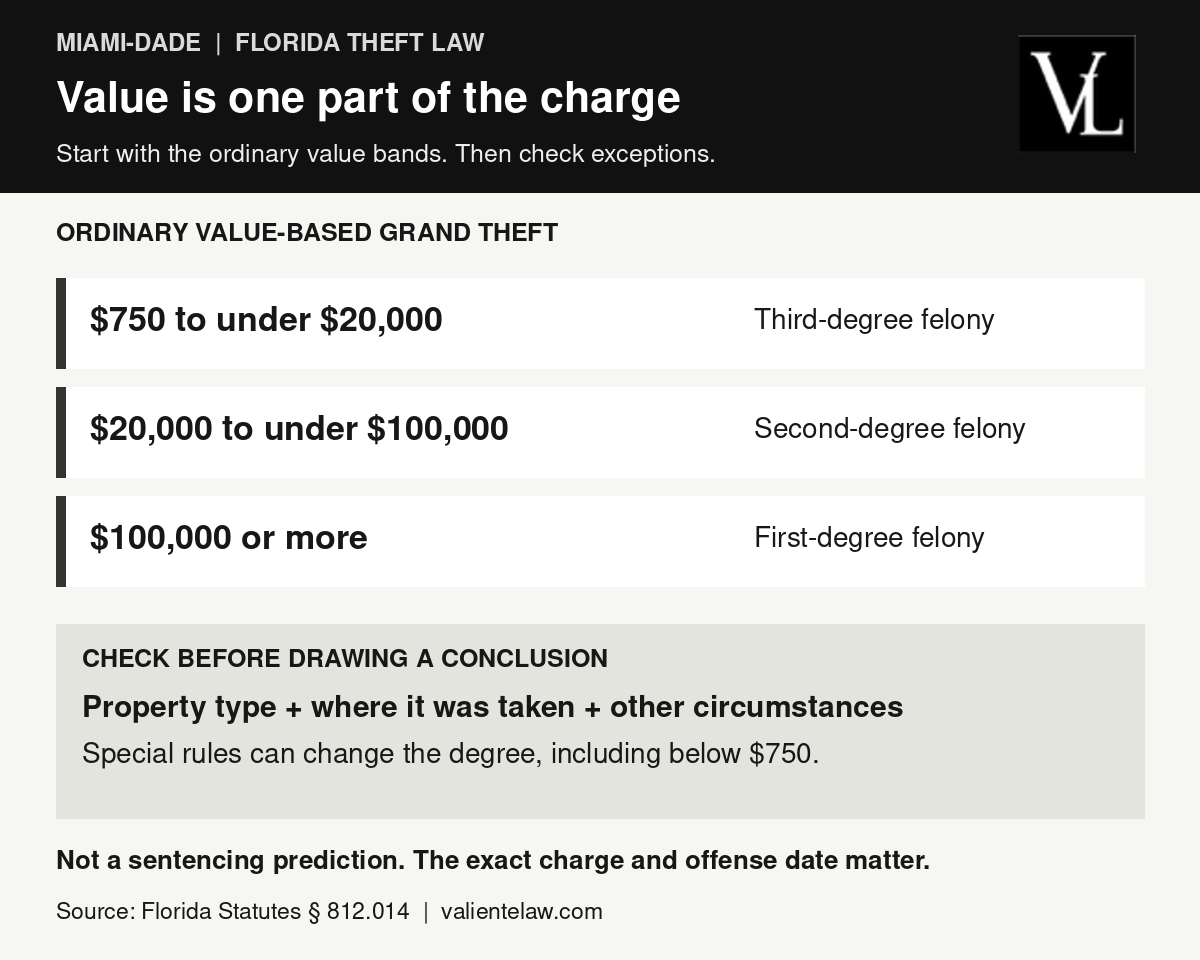
For ordinary value-based theft, grand theft begins at $750. But some property and circumstances can make a theft a felony even below that amount. A lawyer should examine the statutory subsection in the charging document rather than rely only on the dollar amount in an arrest report.
Burglary and robbery are separate offenses with their own elements. A grand theft allegation does not by itself establish either one. If your paperwork lists several charges, each needs its own review. Our Florida theft classifications guide explains the broader categories.
Grand theft degrees and penalties
This table summarizes adult value-based grand theft classifications.
| Property value | Felony degree | Maximum prison term | Maximum fine |
|---|---|---|---|
| $750 or more, but less than $20,000 | Third degree | 5 years | $5,000 |
| $20,000 or more, but less than $100,000 | Second degree | 15 years | $10,000 |
| $100,000 or more | First degree | 30 years | $10,000 |
These are statutory maximums, not predictions or automatic sentences. Sentencing enhancements and other statutory provisions can increase the maximum prison term or fine. Court costs and restitution can be separate from a fine.
When the dollar amount is not the whole answer
- Property type: firearms and motor vehicles fall within special grand theft provisions. Their classification cannot be decided solely by the ordinary $750 threshold.
- Where property was taken: property worth $40 or more but less than $750 taken from a dwelling or its unenclosed curtilage can qualify as third-degree grand theft. Unenclosed curtilage refers to the legally covered area associated with the dwelling; whether a particular location qualifies requires review.
- Cargo and equipment: qualifying cargo worth $50,000 or more can support first-degree grand theft. Specified emergency medical or law enforcement equipment worth $300 or more can support second-degree grand theft when the statutory location requirements are met.
- Other circumstances: designated construction sites, certain prior convictions, coordinated theft, qualifying retail conduct, property damage and theft facilitated by emergency conditions can trigger different provisions.
These examples are not exhaustive. For lower-value allegations, review petit theft penalties and first-offense questions, while keeping the statutory exceptions in mind.
How does Florida value property in a grand theft case?
For ordinary property, start with what that particular item would have sold for in that area when the alleged theft occurred. Under Florida’s theft valuation statute, replacement cost within a reasonable time afterward comes into play if the market value cannot be satisfactorily determined.
A used laptop bought for $1,100
Suppose an arrest report lists $1,100 for a three-year-old laptop because that is what its owner originally paid. The receipt identifies the purchase. It leaves another question open: what would a buyer have paid for that model, in that condition, on the date in question? A cracked screen, a recent repair or a different storage capacity could make a comparison misleading.
Look for sales of the same model around the same date and location. Save the listing and its date, and note whether the seller actually received the price shown. A current asking price for a new laptop answers a different question. For an ordinary value-based charge near $750, that distinction can affect the degree the State can prove.

What if several items appear on the report?
Ask for the item-by-item breakdown. Match each amount to a source and check for duplicate entries. Florida permits amounts from separate thefts to be combined when they are part of one scheme or course of conduct. The dates, transactions and claimed connection matter. The statute also allows a fact finder to determine a minimum value in some cases when an exact figure cannot be established.
Is store merchandise valued the same way?
For the retail-theft provisions, Florida defines the value of merchandise by its sale price when it was taken. Save the dated receipt, promotion terms and product code if the price is disputed. Counsel should check the statute charged. Price and intent are separate questions. If an item never rang up, read about a missed scan and proof of retail theft. Florida retail theft statute.
A successful challenge to a dollar figure can affect a value-based charge. Other provisions can make theft a felony because of the property or location, even at a lower value.
What should a grand theft defense review?
The State must prove the charge beyond a reasonable doubt. A case review should address both the alleged taking or use and the intent required by law. Useful questions include:
- Identity: do recordings, witnesses and transaction records reliably connect you to the alleged conduct?
- Permission and intent: what was agreed, who could authorize use of the property and what do messages or documents show?
- Ownership interests: who had rights in the property? A shared ownership interest does not automatically establish a defense to interfering with another person’s rights.
- Value and classification: is there sufficient evidence of the legally relevant value or the special category charged?
- Evidence collection: is there a legal basis to challenge the use of statements, a search or other evidence?
Preserve records you already have, including receipts, agreements, messages and photographs. Do not alter or delete them. Tell your lawyer promptly about possible video or witnesses so preservation options can be considered. Returning property or saying that you intended to return it does not, by itself, disprove theft.
What if this is your first grand theft charge?
A first arrest is relevant to evaluating your options, but it does not guarantee a dismissal, diversion or a sentence without incarceration. Reviewing possible resolutions should happen alongside reviewing the evidence and defenses.
Florida’s pretrial intervention statute provides an eligibility route for certain first offenders and people with no more than one prior nonviolent misdemeanor who are charged with a misdemeanor or third-degree felony. Required approvals and other conditions still apply. It is not automatic admission, and this provision does not make every degree of grand theft eligible.
The Miami-Dade State Attorney’s Office describes local pretrial diversion as an alternative to prosecution. Its published description provides for charges to be dropped when an admitted participant completes every condition and remains arrest-free during participation. Your lawyer should confirm the program, eligibility, written terms and effect of completion in your actual case.
Before agreeing, review any required plea or admissions, deadlines, financial obligations and consequences of noncompletion. Do not personally seek a victim’s consent for statutory pretrial intervention; section 948.08 prohibits that contact by the defendant or the defendant’s immediate family. Have your lawyer address the appropriate process.
Noncitizens: review immigration consequences before an agreement
A Florida criminal outcome and a federal immigration outcome are separate questions. A withhold of adjudication can still meet the federal definition of a conviction when a qualifying plea, finding or admission is combined with a court-ordered punishment, penalty or restraint on liberty under 8 U.S.C. § 1101(a)(48).
Do not assume that no jail time, a reduced charge or a program called diversion is automatically safe for immigration purposes. Tell your defense lawyer about your status and concerns before accepting a plea or program agreement. The exact statute, case record, proposed terms and your immigration circumstances need individualized review, with immigration counsel where appropriate.
Common questions about grand theft in Miami-Dade
Can shoplifting be charged as grand theft?
Yes. A retail setting does not make every allegation a misdemeanor. Value and the applicable theft or retail-theft provisions matter. Review the charging document and supporting evidence before assuming which classification applies.
Does returning the property end the case?
No automatic dismissal follows from returning property or paying money. Those facts may matter to the evidence or possible resolution, but the required intent can be temporary, and restitution is a separate issue. Discuss any proposed return or payment with your lawyer and follow court orders.
Can grand theft be reduced to petit theft?
A reduction may be an issue to discuss when the evidence does not support the charged value or category, or as part of negotiations. It is not guaranteed. The ordinary value bands do not override special statutory categories.
Will a first offense mean probation instead of prison?
There is no universal first-offense result. Your lawyer must review the charge, evidence, sentencing scoresheet, history and available resolutions before discussing likely options. The maximum penalties above do not tell you what sentence a particular case will receive.
What should I bring to the consultation?
Bring your arrest or court paperwork, case number, next court date, release conditions and any relevant records you already have. Include prior case dispositions and questions about work, professional licensing or immigration. Keep original documents intact.
Discuss your Miami-Dade grand theft charge with Valiente Law
You do not have to decide how to resolve the case before having the evidence reviewed. Contact Valiente Law to discuss the exact charge, the next required court date and the consequences that matter to you.
Call 305.764.5460 or request a free, confidential consultation. Se habla español. Falamos português.
This page provides general information, not advice about a particular case. Outcomes depend on the facts and applicable law.