
 WhatsApp
Miami Theft Defense Lawyer
If you are accused of theft in Miami-Dade County, the name on the arrest report is only the beginning of the analysis. The State still must prove the required intent and connect you to the property and conduct at issue. The value and type of property, where it was taken, any prior theft convictions, and the way the case is charged can change the offense level.
Valiente Law represents people facing misdemeanor and felony theft allegations in Miami-Dade County. Call 305-764-5460 for a free and confidential consultation. Se Habla Español.
What Florida Must Prove in a Theft Case
Florida Statute § 812.014 defines theft as knowingly obtaining, using, or trying to obtain or use another person’s property with the intent to do either of the following, temporarily or permanently:
- deprive the person of a right to the property or a benefit from it; or
- appropriate the property for the accused person’s use or for someone who is not entitled to use it.
That intent requirement matters. An accusation, a store report, or possession of disputed property does not by itself answer every element. The evidence and the surrounding facts must be reviewed in the context of the charge.
Petit Theft and Grand Theft in Florida
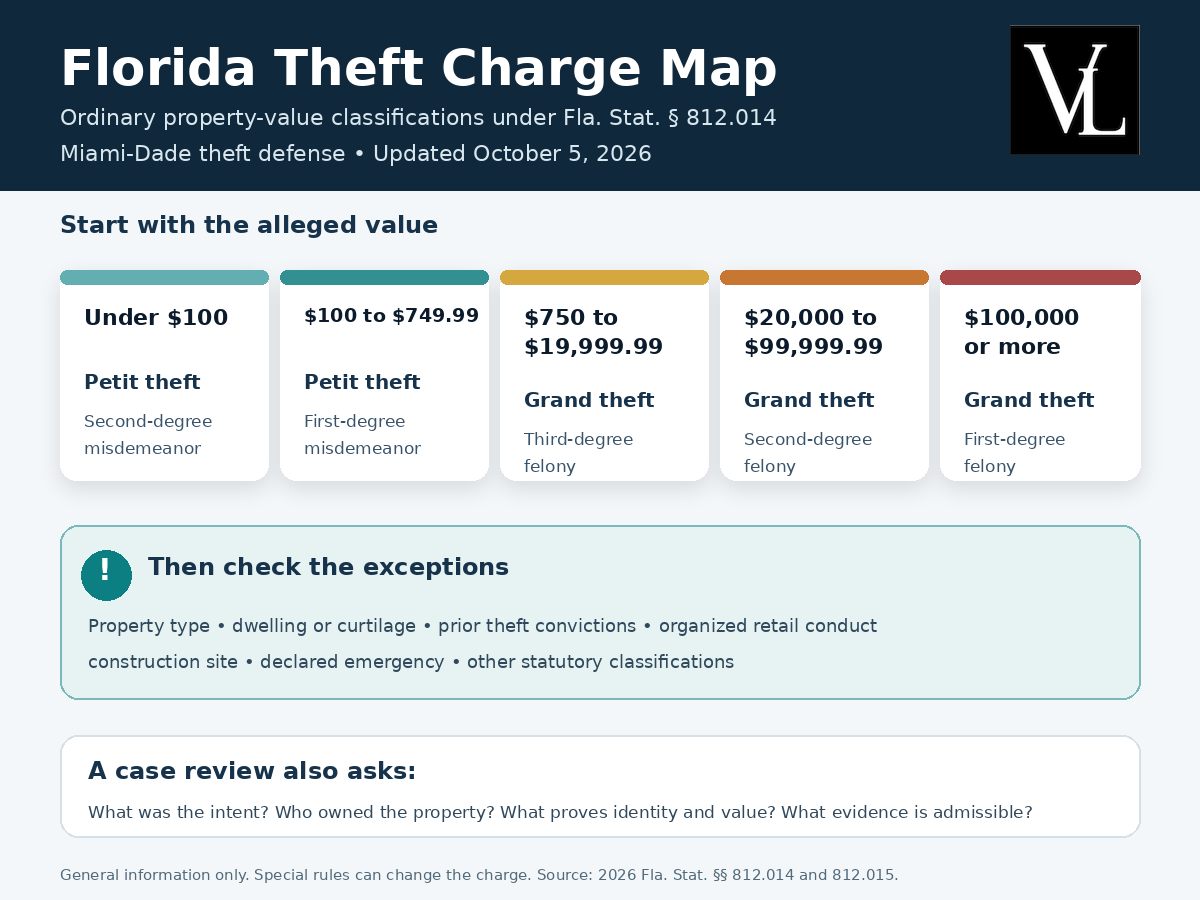
For ordinary value-based theft, Florida generally uses the following classifications. Exceptions can change the result.
| Alleged value | General classification |
|---|---|
| Less than $100 | Second-degree petit theft, a misdemeanor |
| $100 or more but less than $750 | First-degree petit theft, a misdemeanor |
| $750 or more but less than $20,000 | Third-degree grand theft, a felony |
| $20,000 or more but less than $100,000 | Second-degree grand theft, a felony |
| $100,000 or more | First-degree grand theft, a felony |
These are the ordinary value bands, not a complete charging chart. A lower-value allegation can still be treated differently because of the type of property, where it was taken, prior theft convictions, conduct during a declared emergency, or the organized retail theft statute. For example, Florida law has specific rules for property taken from a dwelling or its unenclosed curtilage, firearms, motor vehicles, designated construction sites, controlled substances, and certain other property.
For a focused explanation of misdemeanor charges, see our petit theft and shoplifting page. For felony allegations, see our grand theft page.
Learn how property value is proved in a grand theft case and why statutory exceptions also matter.
For first-offense questions and possible next steps, see our petit theft guide.
Shoplifting and Retail Theft
Florida’s retail theft statute covers more than carrying merchandise out of a store. Depending on the alleged intent, it can include taking or carrying away merchandise, altering or removing a label, universal product code, or price tag, transferring merchandise to a different container, or removing a shopping cart.
The charge does not turn only on the store’s label for what happened. The prosecution still must prove the applicable elements. The amount and number of alleged incidents, coordination with other people, the number of locations, prior qualifying convictions, and other facts can matter under Florida’s retail theft provisions.
If this is a first arrest or a lower-value shoplifting allegation, read our detailed guide to first-offense petit theft and shoplifting. A first offense does not guarantee diversion, dismissal, or a particular sentence.
Theft-Related Charges Are Not All the Same
The current page groups burglary, robbery, fraud, and identity theft together as if they were interchangeable forms of theft. They are separate offenses with different elements. The charging document and statute should control the analysis.
- Dealing in stolen property: Florida Statute § 812.019 addresses trafficking in property that a person knew or should have known was stolen. It is a separate felony allegation, and the statute distinguishes trafficking from organizing or supervising theft and trafficking.
- Motor vehicle theft: A motor vehicle is specifically addressed under Florida’s theft statute. Visit our motor vehicle theft page for the narrower issue.
- Burglary: Burglary focuses on entering or remaining in a dwelling, structure, or conveyance with the required criminal intent. It is not simply another name for theft. See our burglary defense page.
- Robbery: Robbery involves taking property from a person or the person’s custody through force, violence, assault, or putting the person in fear. The elements are different from ordinary theft.
- Fraud, forgery, and identity-related allegations: These may be charged under statutes outside Chapter 812 and require their own analysis. See our fraud defense page.
Evidence to Review in a Miami-Dade Theft Case
The relevant evidence depends on the allegation. A defense review may include:
- surveillance video and how it was collected and preserved;
- receipts, register records, inventory records, and product information;
- witness statements and identification evidence;
- ownership, permission, and the history of a disputed item;
- the State’s evidence of value;
- text messages, emails, account records, or location information;
- statements attributed to the accused and the circumstances in which they were made;
- search, seizure, and chain-of-custody issues; and
- evidence that bears on intent, mistake, identity, or another explanation for the event.
A video, signed form, or statement can be important evidence. It should be reviewed, not dismissed or treated as automatically conclusive. Its meaning, completeness, reliability, and admissibility depend on the facts and law.
First-Offense and Diversion Questions
Miami-Dade has diversion and alternative-resolution programs, but no one should assume that a theft charge will be dismissed because it is a first arrest. Eligibility and admission can depend on the specific charge, criminal history, facts, prosecutor, program rules, and the person’s ability to complete the conditions.
Before accepting a plea, diversion agreement, or other resolution, the person should understand the required admissions, costs, conditions, consequences of noncompletion, and effect on the criminal record. Noncitizens should also obtain advice about federal immigration consequences before accepting any disposition.
Theft Charges and Immigration Status
A theft case can have consequences beyond the Florida criminal case for a person who is not a United States citizen. Federal immigration law uses its own definition of a conviction. In some circumstances, a plea with adjudication withheld can still count as a conviction for immigration purposes when the federal statutory requirements are met.
The immigration analysis is fact-specific. It can depend on the exact statute, charging language, plea, sentence, record of conviction, and the person’s immigration history. A promise of diversion, a withhold of adjudication, or a later record-sealing result should not be treated as proof that a resolution is immigration-safe. Criminal defense and qualified immigration counsel should coordinate before a plea or admission.
What to Do After a Theft Arrest or Notice to Appear
- Save receipts, messages, photographs, account records, and other material related to the allegation.
- Do not delete or alter potential evidence.
- Do not post about the incident on social media.
- Follow release conditions and court dates.
- Avoid contacting an alleged victim or witness if a court order or release condition prohibits it.
- Get advice before giving a new statement or accepting a resolution.
An early review can identify the correct charge, the evidence that needs to be preserved, and deadlines that should not be missed.
Frequently Asked Questions About Miami Theft Charges
Is shoplifting the same as petit theft in Florida?
Shoplifting is commonly used to describe retail theft conduct. The criminal charge may be petit theft or grand theft depending on value and other facts, while the separate retail theft provisions can apply to specified conduct such as coordinated or repeated thefts. The charging document and statute should be reviewed.
What is the difference between petit theft and grand theft?
For ordinary value-based theft, property valued below $750 is generally petit theft and property valued at $750 or more is generally grand theft. Special property, location, prior-record, emergency, and retail-theft rules can change the classification.
Can a theft involving less than $750 still be charged as a felony?
Yes. Florida law contains exceptions based on the property, location, prior theft convictions, and other circumstances. The value alone does not answer every classification question.
Will a first theft charge be dismissed?
Not automatically. A first-time defendant may have options that are not available in every case, but dismissal, diversion, and sentencing decisions depend on eligibility, the evidence, the prosecutor, the court, and successful completion of any required conditions.
Does store video or a written statement end the case?
No single category of evidence should be evaluated in isolation. Counsel can review whether a recording or statement is complete, reliable, lawfully obtained, admissible, and consistent with the other evidence. That review does not guarantee suppression or dismissal.
Can a withhold of adjudication protect a noncitizen from immigration consequences?
Not necessarily. Federal immigration law can treat some pleas with adjudication withheld as convictions. A noncitizen should obtain case-specific criminal and immigration advice before entering a plea, making an admission, or accepting diversion.
Does a dismissal or withhold automatically clear the record?
No. Sealing or expunction is a separate process with eligibility requirements, and immigration agencies may apply different rules. See our Florida record sealing and expunction guide for general information.
Speak With a Miami Theft Defense Lawyer
If you are facing a theft investigation, notice to appear, misdemeanor case, or felony charge in Miami-Dade County, Valiente Law can review the accusation, the evidence, and the consequences that matter to you.
Call 305-764-5460 or use our online contact form for a free and confidential consultation. Se Habla Español.