
 WhatsApp

What Happens at an Arraignment in Miami-Dade?
An arraignment is the stage of a Florida criminal case when the formal charge is addressed and you are called on to enter a plea. It is usually not a hearing where witnesses testify about whether you committed the crime.
If you have an arraignment coming up in Miami-Dade County, confirm the date and attendance requirements with your lawyer. Do not assume that hiring a lawyer, posting bond or filing paperwork lets you skip court.
Call 305-764-5460 for a free, confidential consultation. Se habla español. Falamos português.
What happens at an arraignment?
The court identifies the charge or charges against you and asks for a plea. The prosecutor may also announce a filing decision. The formal charges can differ from the charges listed when you were arrested.
Under Florida Rule of Criminal Procedure 3.160, the charge can be read aloud or its substance explained. The reading can be waived. Waiving that reading does not dismiss the charge.
Your lawyer can review the charging document, explain what the State must prove and discuss the next step. If you do not have a lawyer, tell the court and ask about your right to counsel. If you cannot afford private counsel, ask whether you qualify for appointed counsel. Do not assume that you must plead guilty because you cannot pay for a lawyer.
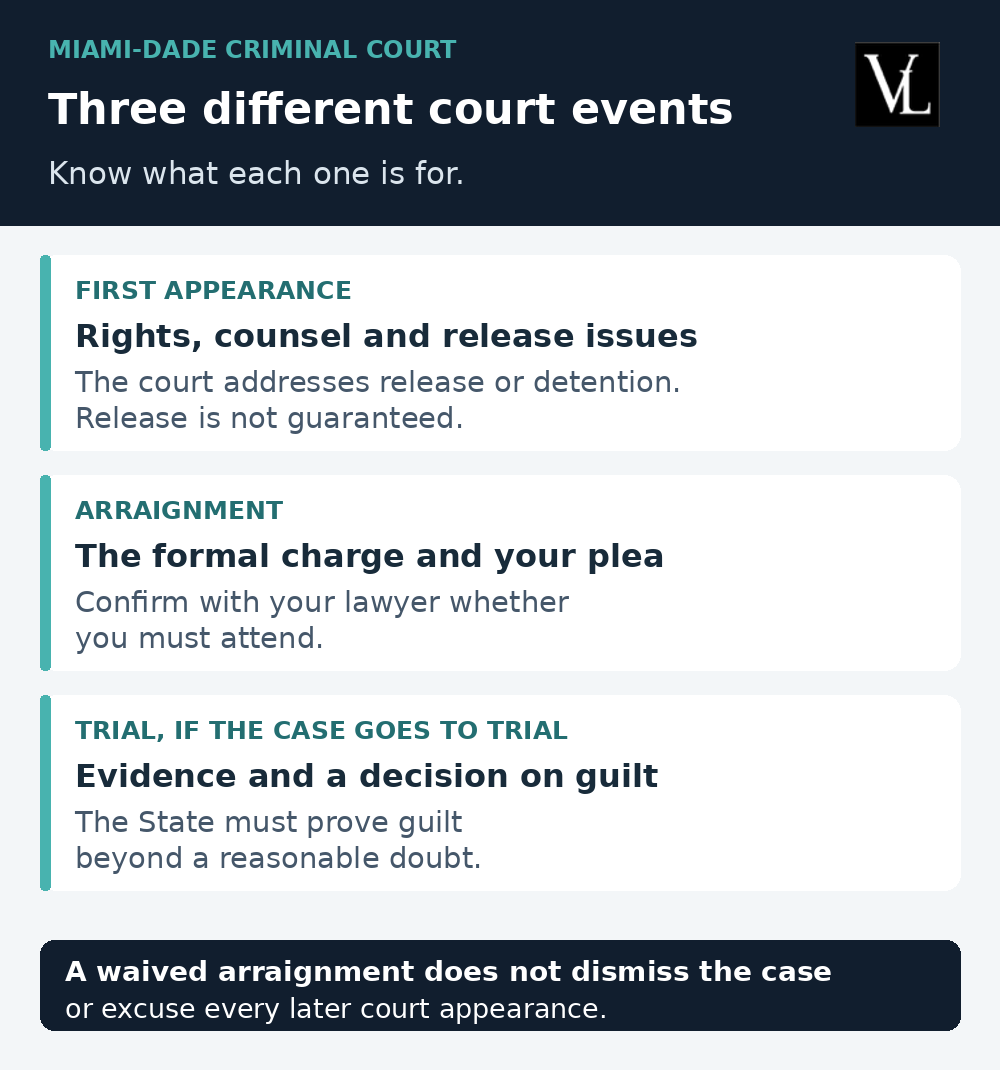
Arraignment, first appearance and trial serve different purposes
First appearance: The court addresses rights, counsel and applicable release or detention issues after an arrest. This is often what people mean by a bond hearing. Release is not guaranteed.
Arraignment: The formal charge and plea are addressed. It is usually not the time to present your full defense or argue with witnesses.
Trial: If the case goes to trial, evidence is presented and the State must prove guilt beyond a reasonable doubt. A not-guilty plea does not mean that a trial is certain. Cases may be resolved in other ways.
If your family is trying to locate someone in custody or understand release, start with our Miami-Dade jail and TGK bond guide.
What pleas are available?
Florida rules allow a plea of not guilty, guilty or, with the court’s consent, no contest. The legal term for no contest is nolo contendere.
- Not guilty: You dispute the charge and keep the case open for a defense. Your lawyer can investigate the evidence and discuss available options.
- Guilty: You admit the charge. If the court accepts the plea, it can lead to a sentence without a trial.
- No contest: You do not contest the charge. It can also lead to a sentence without a trial. It does not mean the case disappears.
Talk with a lawyer before choosing a plea. Understand the charge, possible sentence and effects on your record, work and other concerns. Wanting to finish the case quickly is understandable, but it is not a substitute for knowing what you are agreeing to.
Can my lawyer waive my arraignment?
Rule 3.160 allows counsel for a represented defendant to file a written not-guilty plea at or before arraignment. When that is done under the rule, the arraignment is deemed waived.
That is a specific procedure. A phone call to a lawyer or a notice that a lawyer represents you is not, by itself, the written plea described in the rule. It also does not excuse you from every future hearing.
Before deciding not to attend, get confirmation from your lawyer that the proper filing has been made and that you do not need to appear for the scheduled proceeding. Follow any separate court order. Ask about the next hearing and whether you must attend it in person or by an authorized remote connection.
How to prepare for your Miami-Dade arraignment
- Confirm the details. Check the case number, date, time, courthouse, courtroom and any approved remote instructions. Do not rely on the location used for a different hearing.
- Send your lawyer the paperwork. Include the arrest or notice-to-appear papers, court notice, release conditions and any charging document you received.
- Discuss your plea before the hearing. Ask what the State has filed, what is still unknown and what the next step means.
- Raise practical problems early. Tell counsel about work, travel, childcare, disability accommodations or the need for a court interpreter. Do not assume a family member can serve as your interpreter.
- Keep following existing orders. An arraignment or waiver does not, by itself, remove release conditions or a no-contact order.
For a first misdemeanor, such as a petit theft allegation, ask about the evidence and available options before accepting a result. A first case does not guarantee diversion or dismissal. Our Miami misdemeanor defense page explains the broader issues.
If you are not a U.S. citizen
Tell your defense lawyer privately before entering any guilty or no-contest plea. Ask for advice about the exact proposed outcome, with immigration counsel involved when needed.
A Florida criminal case and federal immigration consequences are separate legal questions. A misdemeanor, a sentence without jail or a withhold of adjudication is not automatically safe for immigration purposes. Florida’s plea rule warns that an accepted guilty or no-contest plea may affect immigration status even when adjudication is withheld. Do not rely on a general warning to tell you what will happen in your own case.
Common arraignment questions
Does waiving arraignment mean the charges were dropped?
No. A waiver under Rule 3.160 concerns the arraignment procedure. It does not dismiss the case or cancel later court dates. Ask your lawyer to explain the current case status and next required step.
Will I be sentenced at arraignment?
Entering a not-guilty plea is not a sentencing decision. An accepted guilty or no-contest plea can lead to sentencing, sometimes at the same proceeding. Review any proposed plea and sentence with counsel before agreeing.
What happens after a not-guilty plea?
The defense can prepare the case, review evidence and address the next court settings. Later steps may include negotiations, motions or trial. The schedule depends on the case. Get your next date and attendance instructions from counsel.
What if I missed the date or cannot attend?
Contact your lawyer promptly. If you do not have one, contact the clerk for case-status information and seek legal advice. Missing required court can have serious consequences, including a warrant. Do not assume that an explanation sent after the hearing fixes the problem.
Get advice before your next court date
Valiente Law can review your Miami-Dade state criminal case and help you understand the charge, attendance requirements and choices ahead. Call 305-764-5460 or request a free, confidential consultation. Se habla español. Falamos português.
Explore more criminal defense FAQs.
General information, not legal advice for a particular case. The facts, court orders and applicable law control.