
 WhatsApp

Should I Accept a Plea Offer in Miami-Dade?
A plea offer can end a criminal case, but the shortest sentence is not always the best choice. Before you accept, understand the exact charge, the evidence, every condition and the effects beyond court. The decision should reflect your case and your priorities, not a promise that one result is always best.
This guide concerns Florida state-court cases in Miami-Dade County. It is a starting point for a private discussion with your lawyer, not a recommendation to accept or reject a particular offer.
Start with the actual terms
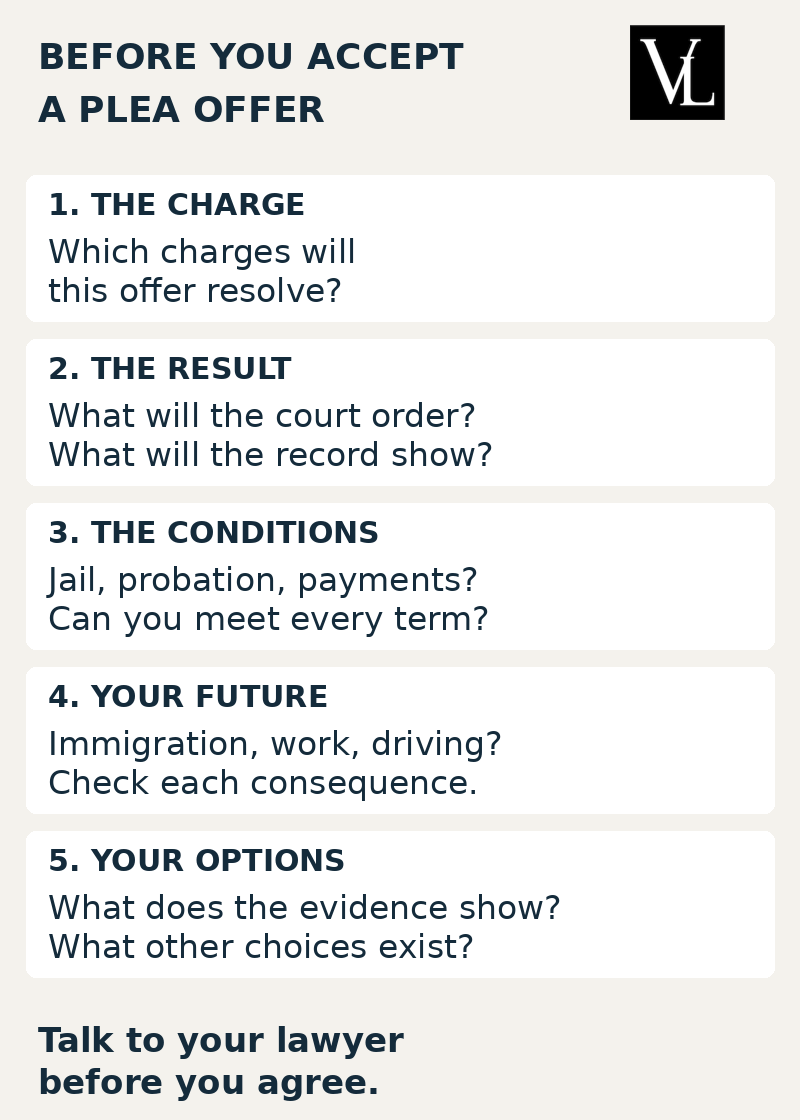
Ask your lawyer to explain the proposed agreement in plain English. Do not rely only on phrases such as “no jail,” “time served” or “a withhold.” Each leaves important questions unanswered.
- Which charge and which counts would the plea resolve?
- Would the judge enter an adjudication of guilt or withhold adjudication?
- Would there be jail, probation, community service, treatment, restitution or other payments?
- Are there driving, travel, contact or other restrictions?
- What is the response deadline, and is any part of the sentence still open?
Ask whether the terms are a prosecutor’s recommendation, an agreement subject to the judge’s acceptance, or an open plea with sentencing left for the court. Under Florida Rule of Criminal Procedure 3.172(g), a plea offer is not binding until the judge formally accepts it after the required review. Ask your lawyer what still must happen in your case.
Compare the offer with the evidence and other options
Your lawyer should review what the State must prove, the available evidence and any legal challenges. A witness problem may matter, but it does not guarantee dismissal. Ask how each strength or weakness affects your choices.
Ask what further investigation could change the assessment. Depending on the facts, counsel may discuss continued negotiations, a motion, trial or a possible diversion program. Each option has limits and risks. A first arrest does not automatically qualify someone for diversion, and an offer is not a promise that a later offer will improve.
For program questions, read our Miami-Dade pretrial diversion guide. If your question is whether you need representation before entering any plea, see why legal advice matters before pleading guilty.
A withhold is not the same as a dismissal
A withhold means the court does not formally adjudicate you guilty. It does not mean the case disappeared or that you were found not guilty. Under Florida’s probation law, supervision can be imposed with or without an adjudication.
A withhold is not available in every case. Section 775.08435 bars withholds for capital, life and first-degree felonies. Second-degree felonies and third-degree domestic-violence felonies require specified grounds, such as a written prosecutor request or qualifying written findings by the judge. Prior felony withholds can further limit or bar relief. Other laws impose additional limits. For example, Florida law prohibits withholding adjudication for DUI under section 316.193.
Review the meaning and limits of a withhold of adjudication before treating it as protection from every consequence. Employment, licensing, firearms, housing, driving and record-relief questions require their own analysis.
Check benefits and background questions separately
A criminal case does not affect every benefit in the same way. A drug conviction alone no longer makes someone ineligible for federal student aid under the former drug-conviction rule. Other eligibility rules, incarceration and any specific federal-benefit order still need review. See the Federal Student Aid eligibility guidance.
A withhold does not give you a blanket right to deny an arrest or case on an application. Read the exact question with your lawyer. Sealing or expungement is a separate process with eligibility rules and exceptions. It does not guarantee that all private background reports disappear. Some records and official access remain, and disclosure duties can differ under Florida and federal law.
Noncitizens need advice before the plea
A Florida withhold can still count as a conviction under federal immigration law. A guilty or no-contest plea combined with a court-ordered penalty or restraint can meet the federal definition even without a formal state adjudication.
Tell defense counsel about your immigration concerns privately before agreeing to terms. Ask for advice about the specific charge, proposed plea and sentence, with immigration counsel involved when needed. A misdemeanor label or a no-jail offer does not establish immigration safety.
Make sure you can complete the conditions
Tell your lawyer about work hours, transportation, medical needs and your ability to pay. Ask how treatment, community service and reporting would fit your life. Do not accept terms you do not understand or assume that missed obligations will be excused. Keep copies of the plea paperwork and final court orders.
Common questions about plea offers
Should I accept because this is my first charge?
Not for that reason alone. Your record is one factor. The evidence, legal options, offer and personal consequences still need review.
Does “no jail” mean no criminal record?
No. It describes only one part of an offer. Ask what disposition will be recorded and whether any record-relief process may be available. Nothing is automatically erased by a no-jail agreement.
Is a no-contest plea harmless for immigration?
No. Federal immigration law can treat a no-contest plea with a penalty or restraint as a conviction. Get case-specific advice before entering it.
Can I change my mind after the judge accepts the plea?
Do not assume you can undo it. Withdrawing an accepted plea requires a legal basis and court action. Talk to your lawyer before entering the plea, and seek advice promptly if a problem arises afterward.
What if the offer expires soon?
Contact your lawyer promptly. Ask what remains to be reviewed and whether more time can be requested. Do not ignore a deadline or assume an extension will be granted.
Discuss your offer with Valiente Law
Bring the offer, charging documents, court dates and release conditions. Explain your priorities and any immigration, employment, licensing or driving concerns. Call 305-764-5460 or contact Valiente Law for a free, confidential consultation about a Miami-Dade state criminal case.